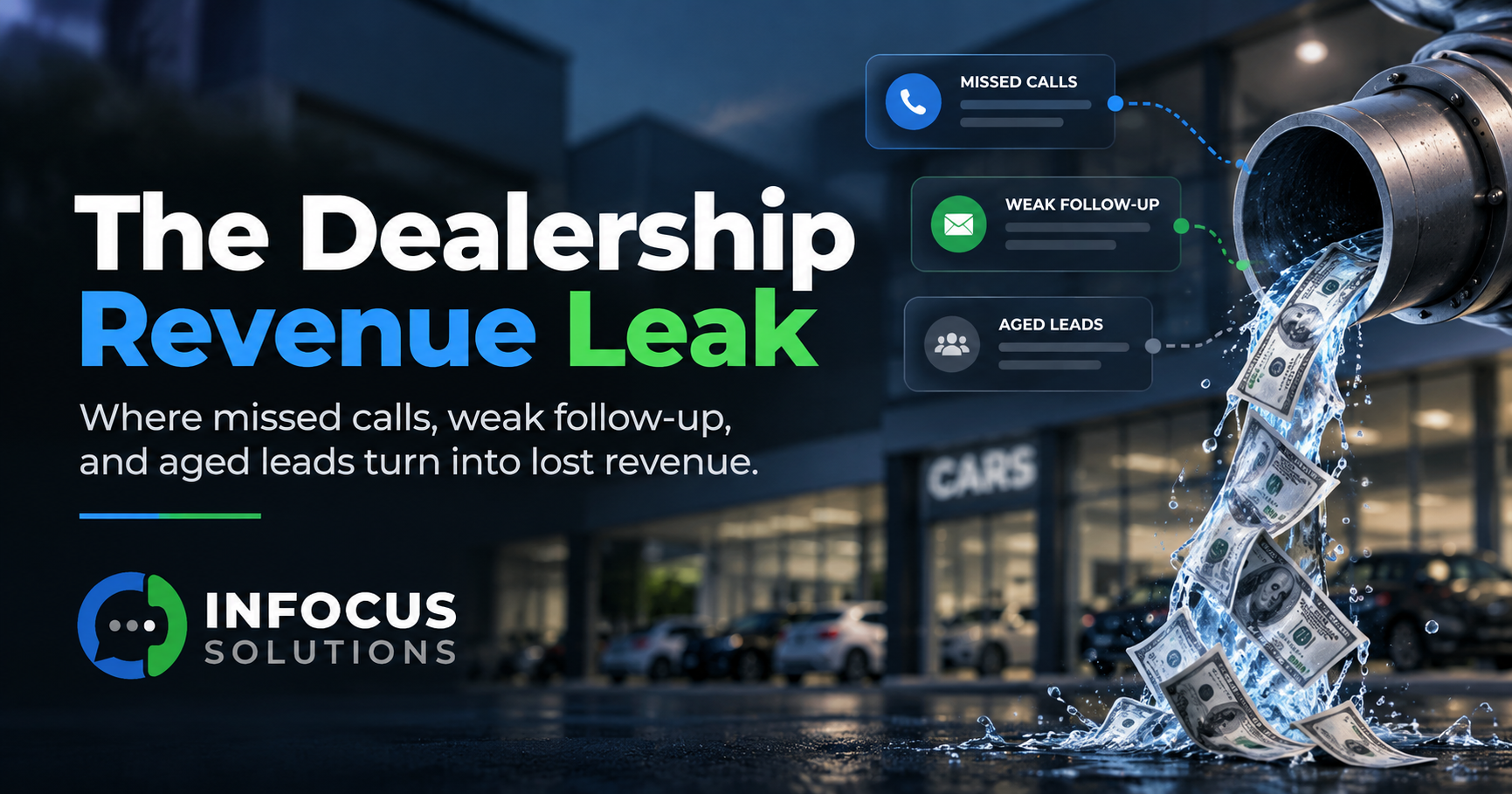




There’s a conversation that happens in dealerships every day.
Traffic is down. Sales are soft. Appointment volume isn’t where it needs to be.
So the first reaction is usually predictable:
We need more leads.
Maybe.
But before you increase the ad budget, add another third-party lead source, or launch the next campaign, there’s a much less exciting question worth asking:
What happened to the opportunities you already paid for?
That question tends to uncover a lot.
The internet lead that got three calls and disappeared into the CRM. The Saturday phone call nobody picked up. The appointment that was set but never confirmed. The customer who declined $1,500 worth of service work six months ago and hasn’t heard from the store since.
None of those show up neatly on a marketing report as “lost revenue.”
But that’s exactly what they are.
And in many stores, fixing those gaps can be more valuable than simply pouring more leads into the top of the funnel.
Revenue Leak #1: Follow-Up Stops Too Soon
Fresh internet leads get attention.
A lead that came in eight minutes ago is exciting. A lead from eight days ago? Not so much.
That’s where a lot of dealership lead follow-up starts breaking down.
The sales floor gets busy. New leads keep coming in. A customer doesn’t respond to the first few attempts, and eventually that lead becomes another name sitting in the CRM.
The problem is that customers don’t shop on the dealership’s schedule.
Someone may submit a lead Monday night, get buried at work Tuesday, talk to their spouse Wednesday and finally be ready to have a real conversation Friday afternoon.
If the dealership stopped seriously working the opportunity on Wednesday, somebody else may get that conversation.
Good follow-up isn’t about hammering customers with the same voicemail every day.
It means having an actual process.
Calls. Texts. Emails. Different times of day. Different messaging. Clear ownership inside the CRM.
And, most importantly, somebody is responsible for making sure it happens.
That’s one of the core jobs of a strong automotive BDC. The BDC creates consistency when the sales floor naturally has other priorities competing for its attention.
Revenue Leak #2: Nobody Owns the Phone When the Store Gets Busy
Think about a Saturday afternoon in a dealership.
The showroom is full.
Managers are working deals.
Salespeople are bouncing between customers.
The service drive hasn’t slowed down since 8:00 a.m.
And the phone rings.
That’s exactly when an inbound call is most likely to become somebody else’s customer.
Inbound calls are easy to underestimate because they don’t feel like a traditional lead source. But somebody calling the dealership usually has a reason.
They want to know whether a vehicle is available.
They have a question about a trade.
They need a service appointment.
They’re checking on a repair.
They’re trying to reach someone.
The customer doesn’t care that the dealership is having a busy Saturday. They just know nobody answered.
That’s why dealership inbound call support should be treated like an opportunity-handling function, not simply a receptionist function.
Sometimes the right outcome is an appointment.
Sometimes it’s a hot transfer.
Sometimes it’s simply getting a complete message to the correct person.
The important thing is that the customer doesn’t disappear because everyone inside the store was doing exactly what they were supposed to be doing.
Revenue Leak #3: You Measure Appointments Set, But Not What Happens Next
A big appointment number can make a BDC report look great.
Until you look at the showroom.
Setting the appointment isn’t the finish line.
You need to know:
Was it confirmed?
Did the customer show?
Did the salesperson know they were coming?
What happened when they arrived?
Did they buy?
A dealership can have a healthy appointment set rate and still have a broken process.
Sometimes the problem isn’t appointment setting at all. It’s everything that happens between the initial “yes” and the customer walking through the front door.
Confirmation matters.
The handoff matters.
The CRM notes matter.
And the customer shouldn’t have to walk into the dealership and start the entire conversation over again with somebody who’s never heard of them.
That’s why we like looking beyond raw activity numbers.
Calls made and appointments set tell part of the story.
Shows and sales tell you whether the process actually worked.
Revenue Leak #4: Your CRM Is Full of People Everyone Has Given Up On
Most dealerships have a CRM graveyard.
You know exactly what we’re talking about.
Aged internet leads.
Unsold showroom traffic.
Old campaign leads.
Previous customers.
People who inquired six months ago and never purchased.
Leads assigned to employees who don’t even work at the dealership anymore.
At some point, those records get mentally labeled as dead.
Some of them are.
A lot of them aren’t.
That’s what makes CRM reactivation for dealerships so interesting.
You’re not paying to generate a brand-new name.
You’re going back to somebody who already had a relationship with the store, already expressed interest, or already raised their hand at some point.
Circumstances change.
Vehicles change.
Inventory changes.
Payments change.
Trade positions change.
People who weren’t ready six months ago may be ready today.
The opportunity was already created.
It just stopped being worked.
A good dealership lead reactivation campaign isn’t blasting thousands of generic emails asking, “Are you still interested?”
It’s identifying the right segments, giving the customer a reason to have a conversation again, and putting real follow-up behind it.
Revenue Leak #5: There’s Revenue Sitting in the Service Drive Too
Sales isn’t the only place this happens.
Fixed operations may have an even bigger follow-up problem because the opportunity can be buried inside work the dealership already knows the customer needs.
Declined service.
Overdue maintenance.
Missed appointments.
Open recalls.
Customers who haven’t returned in 12 months.
Customers who never scheduled their next visit.
The service advisor knows follow-up is important.
They also have a customer standing three feet away waiting to hear why their vehicle needs another $900 worth of work.
Guess which one wins.
That’s not an effort problem. It’s a capacity problem.
This is where a dedicated service BDC or outbound service campaign can make a significant operational difference.
The advisor stays focused on the drive.
Someone else works the follow-up.
And instead of letting declined work and lapsed customers age quietly inside the DMS, the dealership has an actual process for bringing those customers back.
Current service-BDC content across the industry is increasingly focused on exactly these areas: declined work, missed appointments, lapsed customers, maintenance, retention, and scheduling. BDC Extensions
Revenue Leak #6: You’re Asking Salespeople to Be Salespeople and BDC Reps at the Same Time
There are salespeople who are fantastic at follow-up.
There are also great salespeople who absolutely hate it.
That’s dealership life.
The person you want working a live customer, building value in a vehicle, appraising a trade and closing a deal may not be the same person you want making the eighth follow-up attempt on an internet lead from last week.
Yet a lot of stores build their process as if those are the same job.
Then management gets frustrated when CRM tasks pile up.
That doesn’t necessarily mean the salesperson is lazy.
It may mean the process is fighting the job.
Salespeople respond to what’s immediately in front of them.
A customer standing on the lot will almost always take priority over a CRM task.
A dedicated BDC structure removes that conflict.
The BDC works the calls, texts, follow-up and appointment-setting process.
The salesperson sells.
That division of responsibility is one of the reasons dealerships evaluate outsourced BDC services in the first place. It’s not always about replacing an internal team. Sometimes it’s about giving the existing team enough support to do its actual job consistently.
Start Measuring Movement, Not Just Activity
This is where managers should get picky about the numbers.
A dashboard full of activity can still hide a terrible customer journey.
Instead of only asking:
- How many calls did we make?
- How many texts did we send?
- How many appointments did we set?
Follow the opportunity farther.
Lead → Contact → Appointment → Confirmation → Show → Sale
On the service side:
Customer Worked → Contact → Appointment → Show → Repair Order
That’s where the leaks become visible.
If contacts are strong but appointments are weak, that’s one problem.
If appointments are strong but shows are terrible, that’s another.
If customers are showing but not buying, blaming the BDC probably isn’t going to fix it.
Good reporting should tell you where the process broke, not just whether everybody looked busy.
Before You Spend Another Dollar Generating Leads
We’re not suggesting dealerships stop advertising.
Far from it.
You need fresh opportunities coming into the store.
But more traffic doesn’t fix a broken follow-up process.
In fact, it can make the problem more expensive.
If your dealership is already generating internet leads, phone calls, service customers, showroom traffic and CRM opportunities, take a hard look at what happens after those opportunities arrive.
How quickly do they get worked?
How long does follow-up continue?
Who owns the next step?
What happens to no-shows?
Who’s calling declined service?
What happens to the lead nobody has touched in 45 days?
And what happens to the phone when everybody in the store is busy?
Those aren’t small operational details.
That’s where revenue leaks.
Find the Leak. Then Fix It.
That’s the idea behind the InFocus Dealership Revenue Leak Audit.
We’re not looking for another reason to tell you that you need more leads.
We look at what you’re already generating and where the execution starts breaking down — lead response, CRM follow-up, inbound calls, appointment handling, aged opportunities, service follow-up and the handoffs between them.
Because sometimes the easiest revenue to find isn’t outside the dealership.
It’s already sitting inside it.
Find the leak. Fix the leak.